<?xml version="1.0" encoding="utf-8"?><feed xmlns="http://www.w3.org/2005/Atom" ><generator uri="https://jekyllrb.com/" version="3.10.0">Jekyll</generator><link href="https://k0ety.net/feed.xml" rel="self" type="application/atom+xml" /><link href="https://k0ety.net/" rel="alternate" type="text/html" /><updated>2026-05-15T03:12:12+00:00</updated><id>https://k0ety.net/feed.xml</id><title type="html">Mid-MO Amateur Radio Club</title><subtitle>The official website of the Mid-MO Amateur Radio Club (K0ETY) in Jefferson City, MO.</subtitle><entry><title type="html">Wireless History on East McCarty Street</title><link href="https://k0ety.net/blog/2026/04/09/wireless-history-east-mccarty-street/" rel="alternate" type="text/html" title="Wireless History on East McCarty Street" /><published>2026-04-09T18:00:00+00:00</published><updated>2026-04-09T18:00:00+00:00</updated><id>https://k0ety.net/blog/2026/04/09/wireless-history-east-mccarty-street</id><content type="html" xml:base="https://k0ety.net/blog/2026/04/09/wireless-history-east-mccarty-street/"><![CDATA[<p><em>The following article was originally published by the ARRL and is reproduced here verbatim. You can view the original article <a href="https://www.arrl.org/news/wireless-history-on-east-mccarty-street">on the ARRL website here</a>.</em></p>

<hr />

<p>History is where you find it, and the very best history is often found in your own backyard. This is the story of what the <a href="http://www.mmccs.com/mmarc">MID-MO Amateur Radio Club</a> in Jefferson City, Missouri, uncovered when its president was asked to give a talk on the National Traffic System (NTS).</p>

<p>I’ve been a traffic man since high school days in the early ’60s. The evolution of all we enjoy today in Amateur Radio stems directly from the efforts of those who pioneered the “routes” and worked the “relays” that put ham radio on the map of public consciousness and political acceptance. Indeed, the ARRL’s very name is a hallowed historic artifact of the structure, established in radio’s earliest years, to deliver messages for the common good.</p>

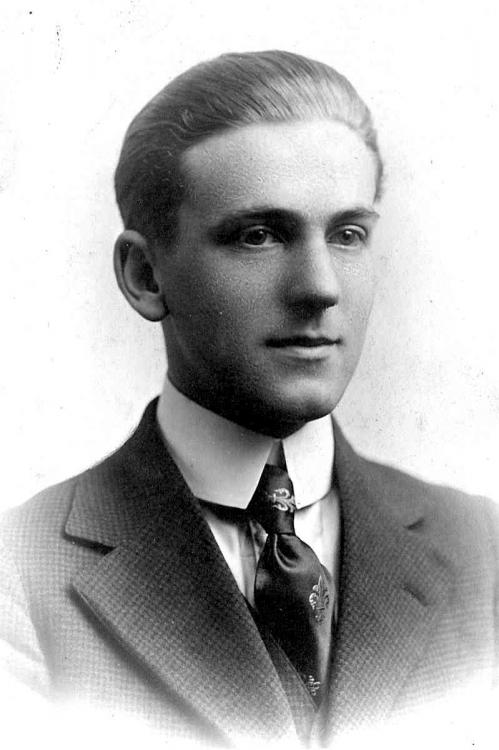
<p>While researching the NTS in Clinton B. DeSoto’s 1936 book, Two Hundred Meters &amp; Down (which every ham ought to own and is available from the ARRL bookstore, <a href="https://www.arrl.org/shop">www.arrl.org/shop</a>) I discovered that a local Jefferson City teenager had figured prominently in the early history of wireless. Thus began 3 years of research into the life and achievements of Willis Porter Corwin, a lad of unusual talents and achievements, whose later life dwindled away tragically.</p>

<p>During the frigid night hours of January 27, 1917, 18 year old Willis received and retransmitted three Morse code messages that became the first successful one-way transcontinental relay of formal message traffic in the history of American radio.</p>

<p>Two weeks later he duplicated that feat by participating in the first two-way relay in which a message originating on the East Coast was passed by successive amateur stations to the West Coast and a reply received back on the East Coast just 80 minutes later, an unheard of feat in those early days of spark-generated signals.</p>

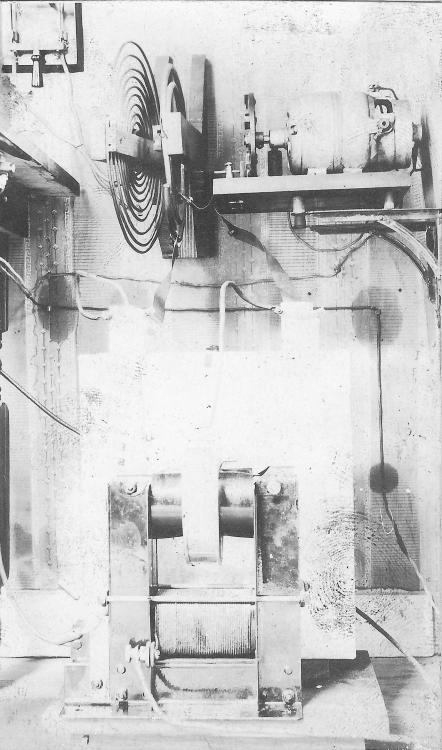
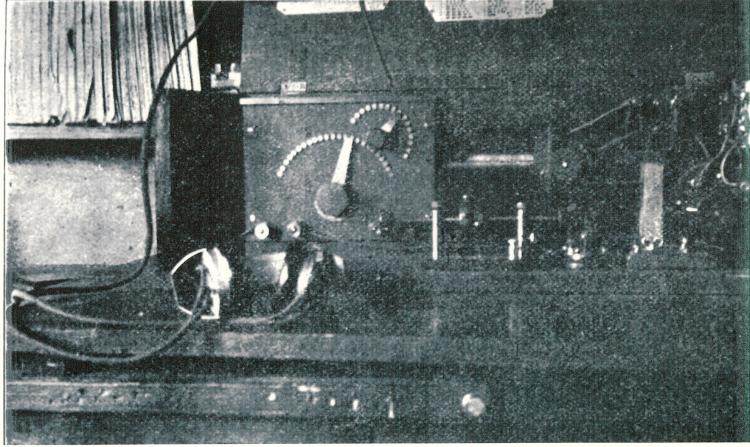
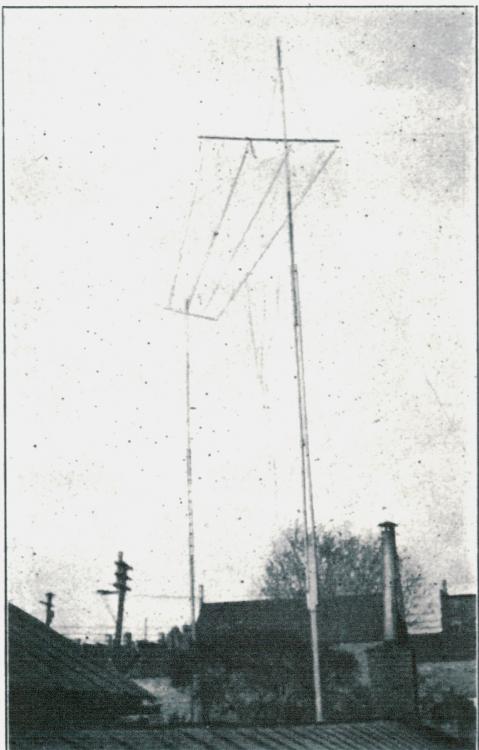
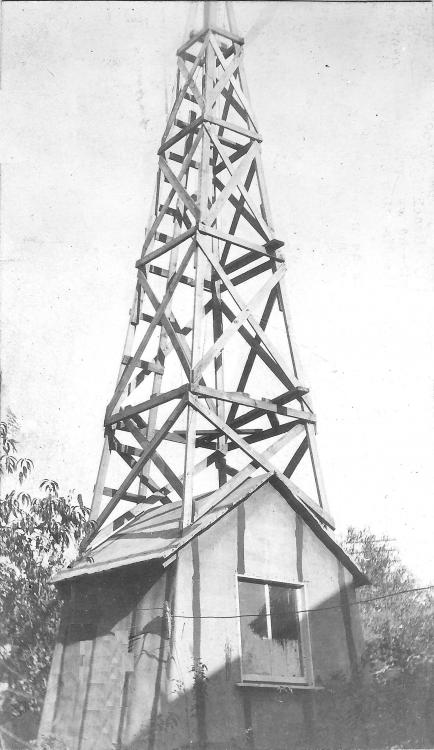
<p>Willis Corwin is Jefferson City’s first-known amateur wireless operator. His call sign, 9ABD, was one of the earliest assigned by the federal government and appears prominently in radio journals of that era. Building his station from radio circuits gleaned from magazines and his own inventiveness, Willis’ radio shack was located in an unheated enclosure at the base of a wooden tower he constructed to elevate his Marconi-style antenna array 85 feet above the backyard of his parents’ residence at 117 E McCarty Street, now a bank parking lot.</p>

<p>Corwin graduated in absentia with the Jefferson City High School Class of 1917, having responded a month earlier to pleas from the United States government for experienced radio operators to serve in the military. He was the first man from Jefferson City to enlist in World War I. He served in France with the United States Naval Reserves as Chief Electrician (Radio) and as wireless operator aboard the troop ship taking him to Europe. Corwin also served as chief radio operator for a time in Navy installations at Great Lakes, Illinois and Manistique, Michigan.</p>

<p>After the war, Corwin built and installed Jefferson City’s first commercial AM broadcast station, WOS, in the dome of the state capitol for the Missouri Department of Agriculture. He later established radio station KSD in St Louis for the St Louis Post-Dispatch where he did pioneering work on wire-photo transmission years before it became a reality.</p>

<p>By the age of 30, Willis’ mental health had deteriorated to such an extent that the last 29 years of his life were spent at the Veterans Administration Home in Knoxville, Iowa. He died there at the age of 60 on January 27, 1959, exactly 42 years to the day after the historic transcontinental record. He is buried in Jefferson City National Cemetery just 9 blocks east of where he grew up.</p>

<p>Clearly, we could not let 9ABD be lost to history. Taking advantage of the January 27 date falling on a Saturday and coinciding with the anniversary of both the transcontinental relay and his death; Mid-MO ARC held three public events to recognize Corwin’s work and publicize Amateur Radio.</p>

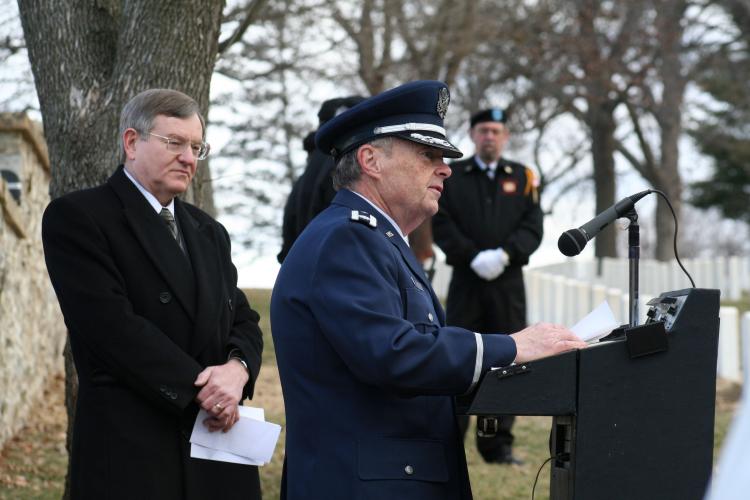
<p>At 10 AM we conducted a wreath-laying ceremony at Willis Corwin’s grave and invited the Honor Guard team from VFW Post 1003 to render Military rites. This is the same post that rendered funeral honors at his burial in 1959. We invited the minister from the church where Willis was baptized to give the invocation and benediction.</p>

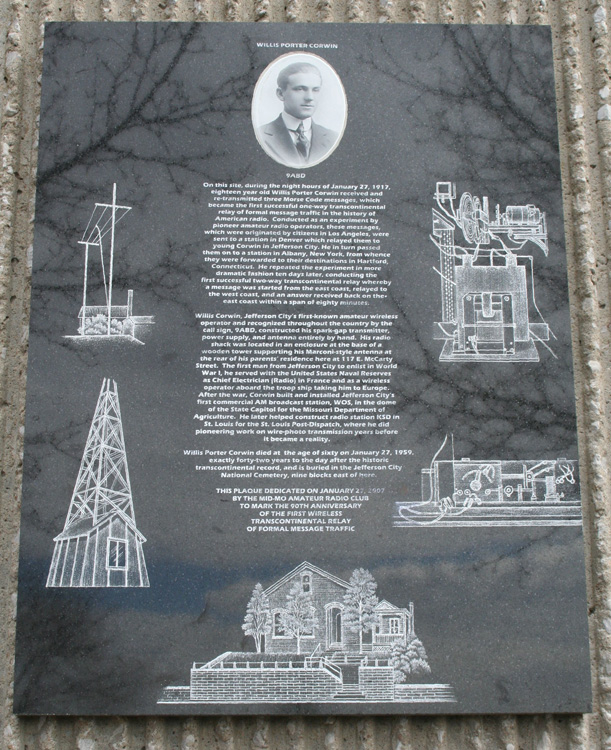
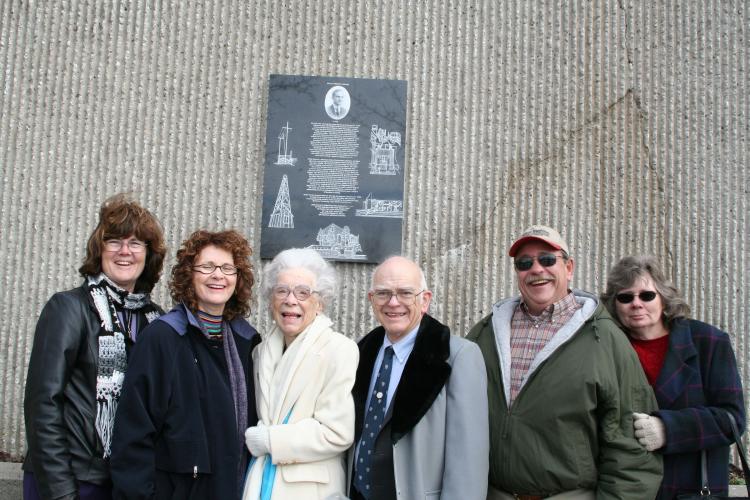
<p>At 11 AM a black granite plaque was dedicated at the site of the Corwin home by Mayor John D Landwehr, assisted by surviving members of the Corwin family and other local dignitaries, and covered by the local media.</p>

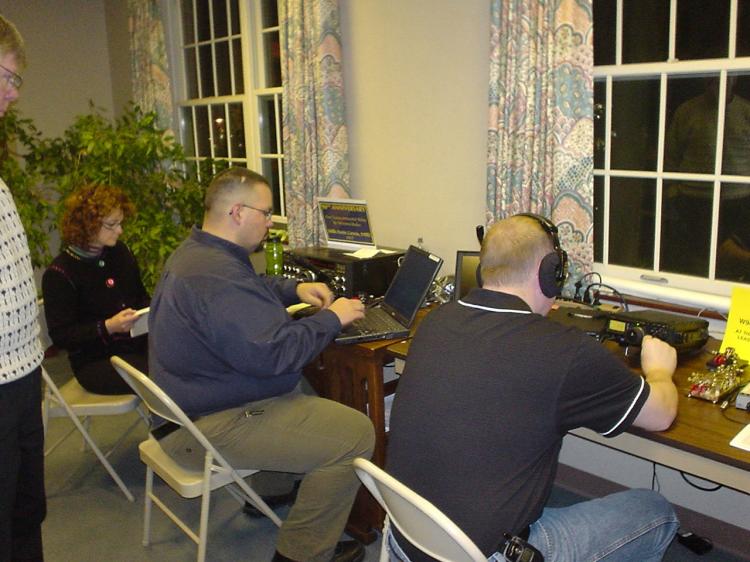
<p>At 2 PM Mid-MO ARC began a 24 hour special event station using the call letters “W9C” specifically selected to mean: “W” for “Willis,” “9” for the district in which Missouri was located in those days and “C” for “Corwin.” Additionally, if you turn the “9” around, it becomes a “P,” for “Porter,” his middle name.</p>

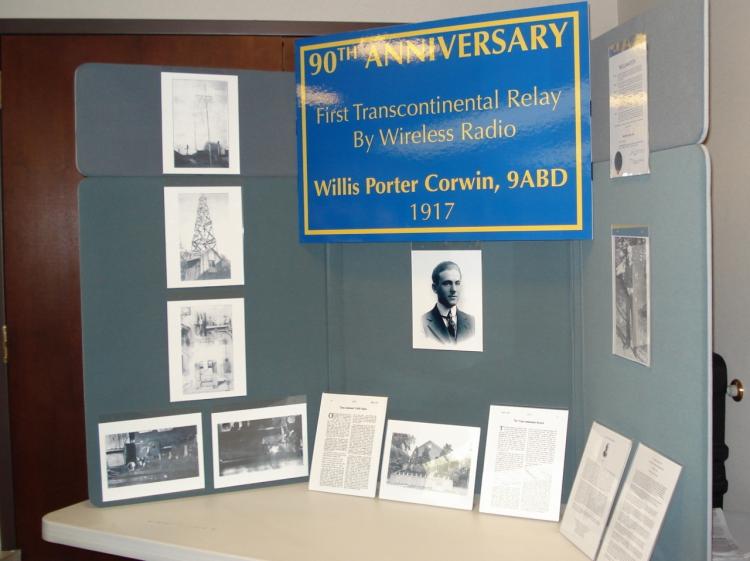
<p>This project generated enormous publicity for Amateur Radio. Our newspaper devoted nearly a full page to the event, complete with photographs of Willis’ original station, shack and Marconi antenna.</p>

<p>A local radio talk show host invited three of us to participate in her hour-long program on the Monday before the event and was so captivated by the project that she invited us back for another hour on Friday.</p>

<p>The Mayor had us appear before the City Council to give an overview of the event and then signed a Proclamation declaring January 27 as “Willis Porter Corwin Day in Jefferson City.”</p>

<p>First Presbyterian Church invited us to conduct our W9C special event station from its mezzanine, which overlooks the Corwin site, and offered their roof for our multiband dipole. The general public had been invited to observe the W9C operation on Saturday afternoon and church members crowded the balcony between services on Sunday to watch us operate and view the display we had assembled.</p>

<p>The bank, which now owns the Corwin property, offered its parking lot for our vertical antenna, which we erected within feet of Willis’ original station. They also graciously permitted us to affix a 33×24 inch black granite plaque to mark the event at the exact site of the Corwin home. Our chief of police offered two squad cars to block off both ends of the street and reroute traffic during the plaque’s dedication.</p>

<p>The city had recently established a “Veterans Plaza” in front of the police station and this gave our radio club the opportunity to purchase a $100 Commemorative Brick to honor Willis’ service as a wireless operator in World War I.</p>

<p>No members of the Corwin family reside in Jefferson City anymore, but we located a nephew, two grandnieces and a grandnephew who made special efforts to attend. Ironically, one of the grandnieces was a former engineer with the FCC Enforcement Division who once helped adjudicate a contentious issue in favor of Amateur Radio. An unexpected benefit of our special event was the opportunity it afforded Corwin’s relatives to learn about their roots and family background, especially “Uncle Willis” of whom they knew very little.</p>

<p>In short, you just never know what historical events of Amateur Radio importance might be lurking in the microfilmed pages of your town’s early newspapers. Many pioneer hams at the local level are in danger of being forgotten. Unless we find them, no one else will.</p>

<p>I wish to thank Gary Halverson, K6QLH, for helping research period electrical journals; Missouri State Historical Society for allowing us access to their files on CB Corwin, Willis’ father, a prominent Missouri newspaper publisher and politician; Myron “Mike” Gwinner, Willis’ nephew, for invaluable help with family photos and history, and members of the Mid-MO Amateur Radio Club who contributed greatly to the success of this event, especially NN0B, W0ESE, W4RK, N0EAX, N0SS, WB0PZR, KC0SJR, K0WYN and N0KSF.</p>

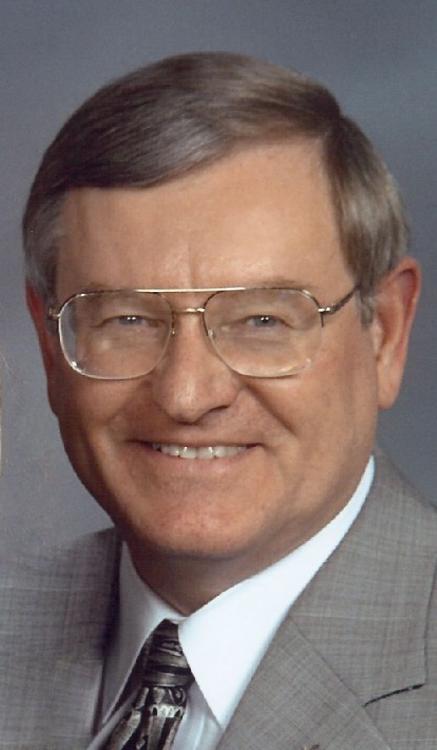
<p>This article was originally published in <a href="http://www.ermag.com">Electric Radio Magazine</a>. All photos courtesy of Kent W. Trimble, K9ZTV.
Kent W. Trimble, K9ZTV, an ARRL Life Member, was first licensed in 1960 as KN9ZTV in Moline, Illinois. An Extra class licensee, he is a member of the ARRL Diamond Club, former Route Manager of the Illinois Section Net (ILN), holds a current League appointment as Net Manager of the Missouri Section Net (MON) and is in his second year as president of Mid-MO Amateur Radio Club. A funeral director, he owns Dulle-Trimble Funeral Home in Jefferson City, Missouri, where he serves on several community boards, commissions and charitable foundations.</p>

<hr />
<h2 id="event-gallery">Event Gallery</h2>

<div class="grid grid-cols-1 md:grid-cols-2 gap-6 mt-8">
    <div class="flex flex-col items-center">
        <img src="/assets/images/nms_455.jpg" alt="Willis Porter Corwin" class="rounded-lg shadow-sm w-full object-cover" />
        <p class="text-sm text-gray-500 mt-2 italic text-center">Willis Porter Corwin</p>
    </div>
    <div class="flex flex-col items-center">
        <img src="/assets/images/nms_445.jpg" alt="The black granite plaque" class="rounded-lg shadow-sm w-full object-cover" />
        <p class="text-sm text-gray-500 mt-2 italic text-center">The black granite plaque</p>
    </div>
    <div class="flex flex-col items-center">
        <img src="/assets/images/nms_446.jpg" alt="Kent W. Trimble" class="rounded-lg shadow-sm w-full object-cover" />
        <p class="text-sm text-gray-500 mt-2 italic text-center">Kent W. Trimble, K9ZTV</p>
    </div>
    <div class="flex flex-col items-center">
        <img src="/assets/images/nms_447.jpg" alt="W9C special event station" class="rounded-lg shadow-sm w-full object-cover" />
        <p class="text-sm text-gray-500 mt-2 italic text-center">W9C special event station</p>
    </div>
    <div class="flex flex-col items-center">
        <img src="/assets/images/nms_448.jpg" alt="Commemorative board" class="rounded-lg shadow-sm w-full object-cover" />
        <p class="text-sm text-gray-500 mt-2 italic text-center">Commemorative board</p>
    </div>
    <div class="flex flex-col items-center">
        <img src="/assets/images/nms_449.jpg" alt="Corwin family members" class="rounded-lg shadow-sm w-full object-cover" />
        <p class="text-sm text-gray-500 mt-2 italic text-center">Corwin family members</p>
    </div>
    <div class="flex flex-col items-center">
        <img src="/assets/images/nms_450.jpg" alt="Steve Harvey, NN0B" class="rounded-lg shadow-sm w-full object-cover" />
        <p class="text-sm text-gray-500 mt-2 italic text-center">Steve Harvey, NN0B</p>
    </div>
    <div class="flex flex-col items-center">
        <img src="/assets/images/nms_451.jpg" alt="9ABD's homebrewed station" class="rounded-lg shadow-sm w-full object-cover" />
        <p class="text-sm text-gray-500 mt-2 italic text-center">9ABD's homebrewed station</p>
    </div>
    <div class="flex flex-col items-center">
        <img src="/assets/images/nms_452.jpg" alt="9ABD's homebrewed station" class="rounded-lg shadow-sm w-full object-cover" />
        <p class="text-sm text-gray-500 mt-2 italic text-center">9ABD's homebrewed station configuration</p>
    </div>
    <div class="flex flex-col items-center">
        <img src="/assets/images/nms_453.jpg" alt="Marconi-style antenna" class="rounded-lg shadow-sm w-full object-cover" />
        <p class="text-sm text-gray-500 mt-2 italic text-center">Marconi-style antenna</p>
    </div>
    <div class="flex flex-col items-center">
        <img src="/assets/images/nms_454.jpg" alt="Wireless shack of Willis Corwin" class="rounded-lg shadow-sm w-full object-cover" />
        <p class="text-sm text-gray-500 mt-2 italic text-center">Wireless shack of Willis Corwin</p>
    </div>
</div>]]></content><author><name>Kent W. Trimble, K9ZTV (Originally published by ARRL)</name></author><category term="news" /><summary type="html"><![CDATA[History is where you find it, and the very best history is often found in your own backyard. This is the story of what the MID-MO Amateur Radio Club uncovered.]]></summary></entry><entry><title type="html">Off-grid Messaging with Meshtastic</title><link href="https://k0ety.net/blog/2026/03/31/meshtastic/" rel="alternate" type="text/html" title="Off-grid Messaging with Meshtastic" /><published>2026-03-31T18:00:00+00:00</published><updated>2026-03-31T18:00:00+00:00</updated><id>https://k0ety.net/blog/2026/03/31/meshtastic</id><content type="html" xml:base="https://k0ety.net/blog/2026/03/31/meshtastic/"><![CDATA[<p>Have you ever wanted to send a text message or share your GPS location from the middle of the woods, miles away from the nearest cell tower? Or perhaps you’re an existing radio operator looking for a new digital mode that builds an autonomous, self-healing network without relying on internet infrastructure.</p>

<p>Enter <strong>Meshtastic</strong>—an open-source project that is taking both the tech and amateur radio communities by storm.</p>

<h2 id="what-is-meshtastic">What is Meshtastic?</h2>

<p>At its core, Meshtastic is a decentralized, off-grid communication network. It allows users to send encrypted text messages and share GPS telemetry using small, low-power digital radios.</p>

<p>Unlike traditional two-way radios where you speak into a microphone, a Meshtastic device (often called a “node”) typically pairs with your smartphone via Bluetooth. You simply open the Meshtastic app on your phone and type a message. The app sends the text to your node via Bluetooth, and the node broadcasts it over the airwaves using <strong>LoRa</strong> (Long Range) digital RF technology.</p>

<p>The “mesh” in Meshtastic is where the magic happens. Every single node in the network acts as a smart repeater. If you try to message a friend who is too far away for your radio to reach directly, your message will automatically “hop” through intermediate nodes in the network until it reaches its destination.</p>

<h2 id="no-license-required">No License Required!</h2>

<p>One of the most appealing aspects of Meshtastic is the extremely low barrier to entry. <strong>You do not need an amateur radio license to use it.</strong></p>

<p>In the United States, Meshtastic operates on the 915 MHz ISM (Industrial, Scientific, and Medical) band. This is a slice of radio spectrum designated for unlicensed low-power devices. Because it requires no exam, no fees, and no callsigns, it’s a phenomenal way for hikers, preppers, and technology enthusiasts to dip their toes into the world of RF communications.</p>

<h2 id="the-ham-radio-perspective">The Ham Radio Perspective</h2>

<p>If you already hold a Technician, General, or Extra class license, you might be wondering, <em>“Why use an unlicensed ISM band when I have access to high-power repeaters?”</em></p>

<p>For hams, Meshtastic offers a fascinating sandbox for digital experimentation:</p>
<ul>
  <li><strong>Infrastructure Independence:</strong> Traditional repeaters require power and internet (for linked networks like DMR). Meshtastic builds a completely ad-hoc, localized network that continues working even if the power grid and cellular networks are entirely down.</li>
  <li><strong>Store-and-Forward Routing:</strong> The network intelligently routes packets based on signal strength and node availability, offering a modern twist on classic packet radio (AX.25).</li>
  <li><strong>Licensed Bands:</strong> While most operate on 915 MHz, licensed hams also have the legal authority to operate Meshtastic software on the 433 MHz band (often requiring different hardware) and at much higher power limits than unlicensed users.</li>
</ul>

<h2 id="capabilities-and-features">Capabilities and Features</h2>

<p>What exactly can you do with it?</p>
<ul>
  <li><strong>Text Messaging:</strong> Send encrypted, private 1-to-1 direct messages, or broadcast to public group channels.</li>
  <li><strong>Location Sharing:</strong> Automatically share your GPS coordinates on a tactical map within the app. Great for keeping track of group members on a hike or during a public service event.</li>
  <li><strong>Smart Routing:</strong> Messages can hop up to 7 times (default is usually 3) to dramatically extend the range of the network. A node on a tall hill can relay messages for dozens of users in the valley below.</li>
  <li><strong>Telemetry and Sensors:</strong> Many nodes can be wired to environmental sensors to report battery voltage, temperature, or humidity across the mesh.</li>
</ul>

<h2 id="the-hardware">The Hardware</h2>

<p>Getting started is surprisingly affordable, with entry-level nodes starting around $30. The radios are built around microcontrollers (like the ESP32 or nRF52) paired with a LoRa radio chip.</p>

<p>Common popular hardware includes:</p>
<ul>
  <li><strong>Heltec V3:</strong> A highly affordable, very common starter device. It features a tiny built-in screen and Wi-Fi/Bluetooth, but requires the user to supply their own battery.</li>
  <li><strong>LILYGO T-Echo / T-Beam:</strong> These nodes often come with built-in GPS modules and larger battery enclosures, making them perfect for mobile tracking and mapping.</li>
  <li><strong>RAK Wireless WisBlock:</strong> Known for having incredibly low power consumption. A RAK node paired with a small solar panel can act as a permanent, self-sustaining mountaintop relay for months or even years!</li>
</ul>

<h2 id="join-the-mesh">Join the Mesh</h2>

<p>With nodes running off standard USB power or tiny lithium batteries, getting on the air takes only a few minutes. All you need is a node, an upgraded antenna (highly recommended, as stock antennas are often poor performers), and a smartphone.</p>

<p>If you are interested in local digital communication or learning more about how RF propagation works, grab a node and turn it on! There is a rapidly growing mesh network right here in Central Missouri, and chances are, your node will pick up a signal the moment you step outside.</p>]]></content><author><name></name></author><category term="news" /><summary type="html"><![CDATA[Have you ever wanted to send a text message or share your GPS location from the middle of the woods, miles away from the nearest cell tower? Or perhaps you’re an existing radio operator looking for a new digital mode that builds an autonomous, self-healing network without relying on internet infrastructure. Enter Meshtastic—an open-source project that is taking both the tech and amateur radio communities by storm. What is Meshtastic? At its core, Meshtastic is a decentralized, off-grid communication network. It allows users to send encrypted text messages and share GPS telemetry using small, low-power digital radios. Unlike traditional two-way radios where you speak into a microphone, a Meshtastic device (often called a “node”) typically pairs with your smartphone via Bluetooth. You simply open the Meshtastic app on your phone and type a message. The app sends the text to your node via Bluetooth, and the node broadcasts it over the airwaves using LoRa (Long Range) digital RF technology. The “mesh” in Meshtastic is where the magic happens. Every single node in the network acts as a smart repeater. If you try to message a friend who is too far away for your radio to reach directly, your message will automatically “hop” through intermediate nodes in the network until it reaches its destination. No License Required! One of the most appealing aspects of Meshtastic is the extremely low barrier to entry. You do not need an amateur radio license to use it. In the United States, Meshtastic operates on the 915 MHz ISM (Industrial, Scientific, and Medical) band. This is a slice of radio spectrum designated for unlicensed low-power devices. Because it requires no exam, no fees, and no callsigns, it’s a phenomenal way for hikers, preppers, and technology enthusiasts to dip their toes into the world of RF communications. The Ham Radio Perspective If you already hold a Technician, General, or Extra class license, you might be wondering, “Why use an unlicensed ISM band when I have access to high-power repeaters?” For hams, Meshtastic offers a fascinating sandbox for digital experimentation: Infrastructure Independence: Traditional repeaters require power and internet (for linked networks like DMR). Meshtastic builds a completely ad-hoc, localized network that continues working even if the power grid and cellular networks are entirely down. Store-and-Forward Routing: The network intelligently routes packets based on signal strength and node availability, offering a modern twist on classic packet radio (AX.25). Licensed Bands: While most operate on 915 MHz, licensed hams also have the legal authority to operate Meshtastic software on the 433 MHz band (often requiring different hardware) and at much higher power limits than unlicensed users. Capabilities and Features What exactly can you do with it? Text Messaging: Send encrypted, private 1-to-1 direct messages, or broadcast to public group channels. Location Sharing: Automatically share your GPS coordinates on a tactical map within the app. Great for keeping track of group members on a hike or during a public service event. Smart Routing: Messages can hop up to 7 times (default is usually 3) to dramatically extend the range of the network. A node on a tall hill can relay messages for dozens of users in the valley below. Telemetry and Sensors: Many nodes can be wired to environmental sensors to report battery voltage, temperature, or humidity across the mesh. The Hardware Getting started is surprisingly affordable, with entry-level nodes starting around $30. The radios are built around microcontrollers (like the ESP32 or nRF52) paired with a LoRa radio chip. Common popular hardware includes: Heltec V3: A highly affordable, very common starter device. It features a tiny built-in screen and Wi-Fi/Bluetooth, but requires the user to supply their own battery. LILYGO T-Echo / T-Beam: These nodes often come with built-in GPS modules and larger battery enclosures, making them perfect for mobile tracking and mapping. RAK Wireless WisBlock: Known for having incredibly low power consumption. A RAK node paired with a small solar panel can act as a permanent, self-sustaining mountaintop relay for months or even years! Join the Mesh With nodes running off standard USB power or tiny lithium batteries, getting on the air takes only a few minutes. All you need is a node, an upgraded antenna (highly recommended, as stock antennas are often poor performers), and a smartphone. If you are interested in local digital communication or learning more about how RF propagation works, grab a node and turn it on! There is a rapidly growing mesh network right here in Central Missouri, and chances are, your node will pick up a signal the moment you step outside.]]></summary></entry><entry><title type="html">Welcome to the new MMARC Website!</title><link href="https://k0ety.net/blog/2026/02/12/welcome/" rel="alternate" type="text/html" title="Welcome to the new MMARC Website!" /><published>2026-02-12T18:00:00+00:00</published><updated>2026-02-12T18:00:00+00:00</updated><id>https://k0ety.net/blog/2026/02/12/welcome</id><content type="html" xml:base="https://k0ety.net/blog/2026/02/12/welcome/"><![CDATA[<p>Welcome to the newly modernized website for the Mid-MO Amateur Radio Club.</p>

<p>We’ve updated our look and feel to be more mobile-friendly and accessible.</p>

<p>Check back here for the latest club news, event announcements, and meeting minutes.</p>]]></content><author><name></name></author><category term="news" /><summary type="html"><![CDATA[Welcome to the newly modernized website for the Mid-MO Amateur Radio Club.]]></summary></entry></feed>